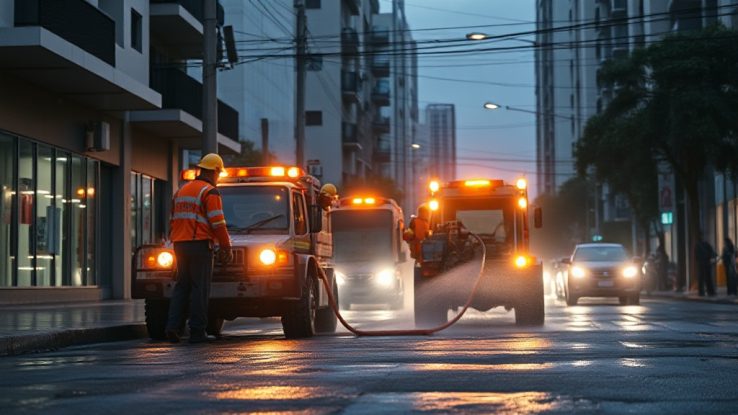
Reading the Streets: Where Blockages Like to Gather in Socorro
Every neighborhood has low points, and the sewers know them better than any map does. If you live in Socorro, on São Paulo’s south side, you have probably noticed that the same corners flood after heavy rain, the same stretch of sidewalk smells faintly of drains on hot days, and the same buildings call for a plumber more often than their neighbors. That pattern is not bad luck. It is geography, zoning and street layout quietly deciding where waste water slows down and solids settle. If you are searching for a desentupidora em Socorro São Paulo SP, the first useful step is to understand why your particular block behaves the way it does.
Why Socorro’s Terrain Makes Some Blocks Vulnerable
Socorro sits in a transitional belt between the flat river basin to the north and the rising ground toward the reservoir country to the south. That means the district is not one uniform slope but a series of terraces, dips and short inclines. Gravity is the engine of every sewer line, so wherever the ground flattens out or briefly reverses, the flow loses speed. When flow slows, grease, soap residue and toilet paper stop traveling and start accumulating.
The most revealing spots are usually not the dramatic hills but the shallow bowls between two rises — places where a street runs level for a hundred meters before climbing again. These quiet stretches collect the debris from everything uphill. Residents often describe them as streets that “always have problems,” but the real issue is hydraulic: the pipe was sized for a certain gradient, and the gradient is doing less work than the designer hoped.
The low points that repeat every rainy season
During the summer storms, water arrives faster than the drains can carry it. In a low point, that excess backs up into the lowest connections first — usually ground-floor drains, garage floor sinks and the small yard drains behind older houses. If your property sits at one of these elevations, a preventive camera inspection before the rainy months is worth more than an emergency call in January.
Why the same house floods twice
A single blockage can be cleared, but if the pipe has a belly — a section where the ground settled and the line dips — solids will gather there again within months. A proper diagnosis checks the pipe’s profile, not just whether water passes today. That distinction separates a temporary fix from a real solution, and it is the kind of assessment a desentupidora Socorro team performs with inspection equipment before recommending a method.
Older Street Layouts and the Pipes Beneath Them
Socorro grew in waves, and each wave left a different plumbing legacy. The oldest lanes near the commercial center were laid out when lots were narrow and buildings shared rear walls. Those blocks often have combined systems, where rainwater and sewage travel in the same pipe. In dry weather the mix is manageable; in a downpour, the rain steals capacity from the sewage, and the whole line backs up.
Newer streets toward the district’s edges were planned with separate networks, but the connections between old and new can be awkward. A building constructed in the 1990s may discharge into a collector built decades earlier, and the junction is where roots find their way in. Tree roots are patient: they enter through hairline cracks at joints and expand until the pipe is half blocked. By the time a resident notices slow drains, the root mass is often the size of a fist.
Shared lines and condominium responsibility
In the older blocks, several houses or a small condominium may share a single lateral connection to the public collector. When that shared stretch clogs, the argument about who pays can delay the repair for days while the problem worsens. Knowing where your private line ends and the shared line begins is essential. A technician can map it, and that map also protects you from being charged for a blockage that originated next door.
What a camera inspection reveals on old streets
A camera run through an older line typically shows one of four things: root intrusion at joints, a sagging section, accumulated grease scale, or a misaligned connection where two pipes meet at an angle. Each has a different remedy. Roots need cutting and often lining; a sag needs relining or replacement; grease scale responds well to high-pressure jetting. Guessing among these options is how homeowners end up paying twice.
Mixed Zoning and the Daily Load on Local Sewers
Socorro is not a purely residential district. Along the main avenues, ground floors hold restaurants, bakeries, laundries and small workshops, while the floors above are apartments. This vertical mix concentrates very different kinds of waste into the same lateral line. A restaurant’s kitchen sends fat and food particles; a laundry sends lint and detergent residue; residents above send the usual domestic load. The pipe does not care about the zoning map, but its capacity does.
Commercial kitchens are the most common source of grease blockages in mixed buildings. Fat cools as it travels and coats the pipe wall, narrowing it gradually. The first sign is often a slow drain in a unit two floors up, far from the kitchen that caused it. This is why a desentupidora Socorro São Paulo SP call in a mixed-use building usually begins with questions about who is on the ground floor.
Signs that a mixed building needs preventive jetting
- Recurring slow drains in upper-floor apartments with no obvious cause.
- A grease trap that fills faster than its rated schedule.
- Gurgling sounds from floor drains when a nearby business uses water.
- Faint sewage odor in stairwells or back corridors during warm weather.
Any two of these together justify a scheduled hydro-jetting visit rather than waiting for a full blockage. High-pressure jetting scours the pipe wall and restores the original diameter, which is far cheaper than repairing a collapsed line.
Trade-offs between quick fixes and scheduled maintenance
A plunger or a hand auger can open a soft clog in minutes, and for a single isolated incident that is reasonable. But on a mixed-use line, mechanical clearing only punches a hole through the blockage; the grease and scale remain on the walls and the clog returns. Scheduled jetting costs more per visit but reduces the frequency of emergencies. The practical rule is simple: one blockage is an incident, two in a year is a pattern, and patterns deserve a maintenance plan.
Reading Your Own Street: A Practical Takeaway
You do not need engineering drawings to understand your block. Start by noticing where water pools after rain and where the sidewalk stays damp longest. Those are the low points, and they are likely where the sewer line also sags. Next, look at what occupies the ground floors around you: a cluster of food businesses means a grease load upstream. Finally, ask how old the buildings are. Pre-1990 construction in Socorro more often has combined or shared laterals, which changes who is responsible when something fails.
With those three observations — elevation, ground-floor use and building age — you can predict your risk with surprising accuracy. If your property sits at a low point, above or below a food business, or on a shared line, a preventive inspection is a sound investment. If it sits mid-slope on a separated system with residential neighbors, you can probably wait for symptoms rather than scheduling work in advance.
The practical takeaway is that blockages are rarely random. They follow the terrain, the plumbing generation of your street, and the daily habits of the businesses and households that share your line. Once you can read those signals, you stop reacting to emergencies and start preventing them — and when you do need help, you can describe the problem precisely enough to get the right method the first time.